What is the difference between generic and personalized LinkedIn lead generation?
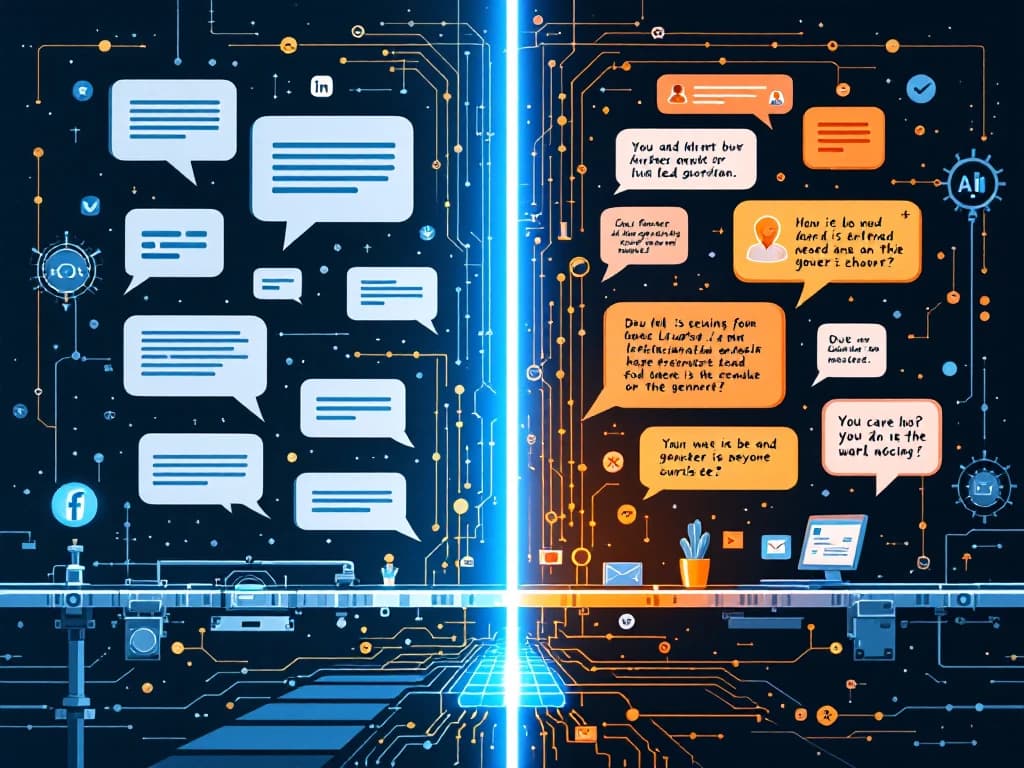
Generic LinkedIn lead generation relies on mass messaging with template-based outreach, typically yielding low response rates due to impersonal communication. Personalized LinkedIn lead generation involves researching individual prospects and crafting tailored messages that reference specific details about their business, interests, or recent activities. This approach generates significantly higher response rates because it demonstrates genuine interest and creates authentic connections that resonate with prospects on a personal level.
What exactly is generic LinkedIn lead generation?
Generic LinkedIn lead generation involves sending identical or slightly modified template messages to large numbers of prospects without personalisation or research. This approach prioritises quantity over quality, often using automated tools to blast the same message to hundreds or thousands of LinkedIn users simultaneously.
The typical generic approach includes copy-paste connection requests with standard messages like "I'd like to add you to my professional network" or "Let's connect!" followed by immediate sales pitches. These messages often contain obvious placeholders, generic industry references, and promotional content that clearly wasn't written for the specific recipient.
This method fails because it treats prospects as numbers rather than individuals. Recipients immediately recognise mass-produced messages, which damages your professional reputation and reduces trust. LinkedIn's algorithm also penalises accounts that send repetitive content, potentially limiting your reach or restricting your account functionality.
Generic outreach typically achieves response rates below 5% because it fails to address the fundamental human need for recognition and relevance. When prospects receive messages that could apply to anyone, they have no compelling reason to respond or engage with your business.
How does personalized LinkedIn lead generation actually work?
Personalized LinkedIn lead generation involves researching each prospect individually and crafting messages that reference specific details about their business, recent posts, shared connections, or industry challenges. This approach treats each prospect as a unique individual with distinct needs and interests.
The process begins with thorough prospect research, examining their LinkedIn profile, recent activity, company updates, and mutual connections. You then craft messages that demonstrate genuine understanding of their situation, perhaps commenting on a recent post they shared, congratulating them on a company milestone, or referencing a mutual connection.
Effective personalised messages often include specific details that prove you've invested time in understanding the prospect. This might involve mentioning their company's recent expansion, commenting on an article they published, or referencing a challenge specific to their industry or role.
The key difference lies in building relationships before making requests. Rather than immediately pitching your services, personalised outreach focuses on establishing common ground, providing value, or starting meaningful conversations about topics relevant to the prospect's interests or challenges.
Why do response rates differ so dramatically between these approaches?
Response rates differ dramatically because personalised messages trigger psychological principles that generic messages completely ignore. Personalised outreach can achieve response rates of 15-30% or higher, while generic messages typically see rates below 5%.
The primary psychological factor is recognition and relevance. When someone receives a message that clearly references their specific situation, achievements, or challenges, it signals that the sender values them as an individual. This creates an immediate sense of importance and makes the recipient more likely to engage.
Trust plays another crucial role in response differences. Generic messages immediately signal that you're running a mass campaign, which reduces credibility and suggests you're more interested in selling than helping. Personalised messages demonstrate investment in the relationship, building trust before making any requests.
Reciprocity also influences response rates significantly. When someone takes time to research your background and craft a thoughtful message, social psychology suggests you're more likely to reciprocate with a response. Generic messages require no investment, so recipients feel no obligation to respond.
Finally, personalised messages stand out in crowded inboxes filled with generic outreach. When most messages are obviously templates, a genuinely personal message immediately captures attention and demonstrates professionalism that prospects want to engage with.
What are the real costs and time investments for each method?
Generic outreach requires minimal time per message but delivers poor results, while personalised outreach demands significantly more time investment but generates substantially better returns. The true cost comparison involves both time and opportunity costs.
Generic LinkedIn lead generation typically takes 1-2 minutes per prospect, including finding profiles and sending template messages. You can easily contact 50-100 prospects daily using this approach. However, with response rates below 5%, you might generate only 2-5 responses from 100 messages, requiring 500+ contacts to generate 25 conversations.
Personalised outreach requires 5-10 minutes per prospect for research and message crafting. This limits daily outreach to 15-25 prospects, but response rates of 15-30% mean those 25 messages could generate 4-8 quality responses. You achieve similar conversation volume with far fewer contacts.
The hidden costs of generic outreach include reputation damage, potential account restrictions, and lower-quality conversations with unqualified prospects. Personalised outreach generates higher-quality conversations with better-qualified prospects who are more likely to convert into customers.
For small businesses, personalised outreach often proves more cost-effective despite higher time investment per prospect. Enterprise organisations might blend both approaches, using personalisation for high-value prospects while maintaining some generic outreach for broader market coverage.
How can you scale personalized LinkedIn outreach without losing authenticity?
Scaling personalised LinkedIn outreach requires combining human insight with intelligent automation that maintains authentic relationship-building while increasing volume. Modern AI-driven platforms can help you achieve this balance through sophisticated personalisation and strategic automation.
The most effective approach involves creating personalisation frameworks rather than individual messages. You can develop templates that incorporate specific research points, recent activities, or mutual connections while maintaining authentic communication. This allows you to personalise efficiently without sacrificing quality.
AI-powered tools can now analyse LinkedIn profiles and suggest personalisation points, helping you identify conversation starters, mutual connections, or recent activities worth mentioning. These insights reduce research time while ensuring each message contains genuine personal touches.
We've developed what we call "parasocial selling" methodology, where AI agents strategically build familiarity and trust with prospects through authentic engagement before direct outreach. This approach scales relationship-building by systematically nurturing connections across large networks while maintaining genuine interactions.
The key lies in automating research and relationship-building activities rather than message creation. Our platform can automatically engage with prospects' content, track their activities, and identify optimal outreach timing while you maintain control over actual message personalisation. This combination allows you to maintain authentic relationships across thousands of connections without losing the personal touch that drives results.
Success in scaled personalisation comes from recognising that AI excels at pattern recognition and relationship nurturing, while humans excel at authentic communication and strategic relationship building. By combining both strengths, you can achieve the volume benefits of generic outreach with the relationship quality of personalised communication.
Frequently asked questions
How do I identify the right personalization details to include in my LinkedIn messages?
Focus on three key areas: recent activity (posts, comments, job changes), company developments (funding, expansions, new products), and mutual connections or shared interests. Look for conversation starters that feel natural and relevant to your offering. Avoid overly personal details or information that seems stalker-like - stick to publicly available professional information that shows genuine business interest.
What's the biggest mistake people make when transitioning from generic to personalized outreach?
The most common mistake is adding surface-level personalization to a generic sales pitch - like mentioning someone's company name but immediately launching into your product features. True personalization means starting conversations about their challenges or interests first, building rapport, and positioning your solution as a natural response to their specific situation rather than a one-size-fits-all offering.
How can I measure if my personalized LinkedIn outreach is actually working?
Track response rates, conversation quality, and conversion rates rather than just connection acceptance rates. Aim for 15-30% response rates on personalized messages versus 5% for generic ones. More importantly, measure how many responses lead to meaningful business conversations and eventual customers. Quality metrics like meeting bookings and qualified leads are more valuable than vanity metrics like total connections.
Is it worth personalizing outreach for lower-value prospects, or should I save time with generic messages?
Create a tiered approach based on prospect value and fit. Use full personalization for high-value, ideal prospects, semi-personalized templates with customizable research points for mid-tier prospects, and consider whether low-value prospects are worth your time at all. Often, focusing entirely on higher-quality prospects with personalized outreach generates better ROI than casting a wide generic net.
How do I avoid coming across as creepy or overly researched in my personalized messages?
Stick to information they've made publicly available and would expect a business contact to know. Reference recent professional posts, company news, or mutual connections, but avoid personal photos, family details, or information from other social platforms. Frame your research as business interest: 'I saw your recent post about supply chain challenges' feels professional, while 'I noticed you vacation in Bali' feels invasive.
What should I do if my personalized LinkedIn messages aren't getting responses despite good research?
Review your message structure - you might be personalizing the opening but still sounding too sales-focused too quickly. Ensure you're asking questions or offering value rather than making requests. Also check your timing, profile optimization, and whether you're targeting the right decision-makers. Sometimes low response rates indicate you need better prospect qualification rather than better personalization.
Can I use AI tools for personalization without losing the authentic human touch?
Yes, but use AI for research and insight generation rather than message writing. AI can help identify personalization opportunities, track prospect activity, and suggest conversation starters, but the actual message crafting should maintain your authentic voice and genuine interest. The best approach combines AI-powered research efficiency with human relationship-building skills.