What is AI sales A/B testing?
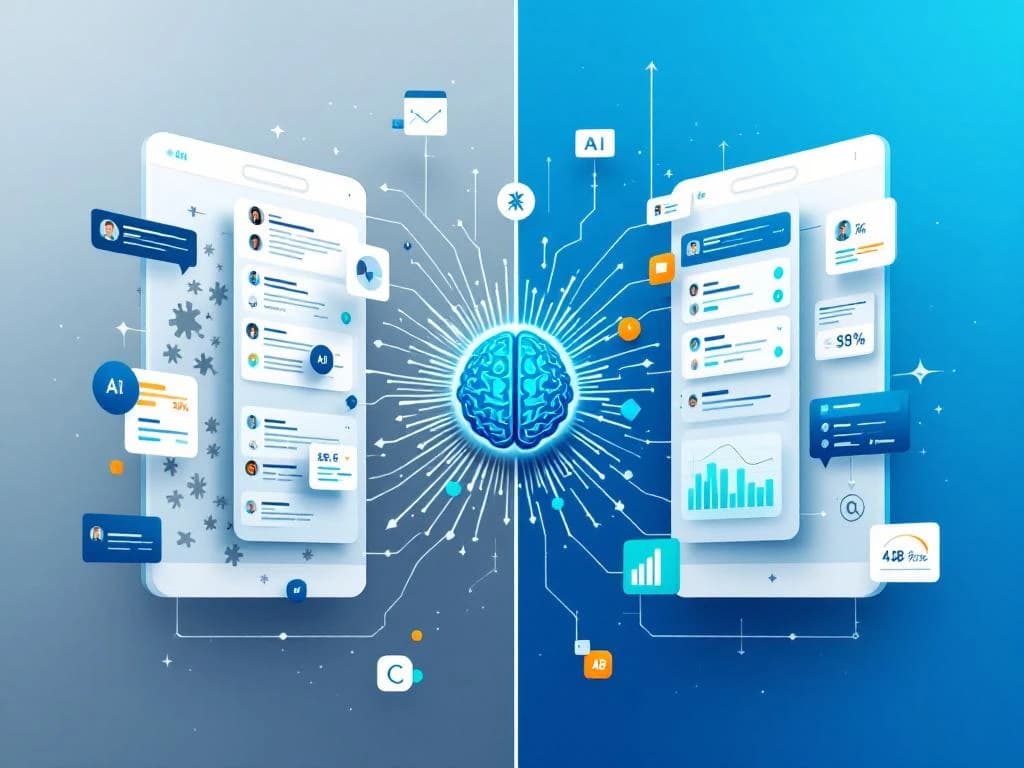
AI sales A/B testing uses artificial intelligence to automatically run multiple versions of sales messages, emails, or outreach campaigns to determine which performs best. The AI system continuously tests different variables like subject lines, message content, and timing, then automatically optimises for better response rates and conversions. This approach delivers faster, more accurate results than manual testing methods.
What exactly is AI sales A/B testing and how does it work?
AI sales A/B testing is an automated approach to testing different versions of your sales content, where artificial intelligence manages the entire testing process. Unlike traditional A/B testing, where you manually create two versions and wait weeks for results, AI systems can test multiple variables simultaneously and make real-time adjustments based on performance data.
The AI works by creating variations of your sales messages, subject lines, calls to action, or even timing strategies. It then distributes these variations across your target audience and monitors key metrics like open rates, response rates, and conversion rates. The system learns from each interaction, identifying patterns that lead to better outcomes.
What makes this different from manual testing is the speed and sophistication. While you might test two email subject lines manually over a month, AI can test dozens of variations across multiple elements simultaneously. The AI also adapts in real time, automatically shifting more traffic to better-performing variations as it identifies winners.
Why should B2B companies use AI for sales testing instead of manual methods?
AI-powered sales testing offers significant advantages over manual methods, particularly in speed, scale, and statistical accuracy. Manual A/B testing typically requires weeks or months to gather meaningful data, while AI systems can identify winning variations within days or even hours, depending on your volume.
The scale advantage is substantial. Manual testing usually limits you to testing one or two variables at a time because managing multiple tests becomes complex and resource-intensive. AI can simultaneously test message content, timing, personalisation approaches, and follow-up sequences across thousands of prospects without overwhelming your team.
Statistical accuracy improves because AI systems automatically calculate significance levels and avoid common human errors like stopping tests too early or misinterpreting results. The AI also eliminates bias by randomly distributing test variations and continuously monitoring for external factors that might skew results.
Resource requirements drop dramatically. Instead of dedicating team members to create test variations, monitor results, and analyse data, your sales team can focus on closing deals while the AI handles optimisation in the background.
What can you actually test with AI sales A/B testing?
AI sales A/B testing covers virtually every element of your sales outreach and follow-up process. Message content is the most common testing area, including different value propositions, pain points, social proof elements, and conversation starters that resonate with your target audience.
Subject lines and opening messages are particularly important for LinkedIn outreach and email campaigns. The AI can test formal versus casual tones, question-based versus statement-based openings, and different personalisation approaches based on prospect data like industry, role, or company size.
Timing optimisation is another powerful testing area. AI can determine the best days of the week, times of day, and intervals between follow-up messages for different prospect segments. This includes testing how long to wait before the first follow-up and the optimal sequence length.
Calls to action and meeting-booking approaches also benefit from AI testing. The system can test direct requests versus softer approaches, different meeting duration offers, and various ways of presenting your value proposition in the final ask.
Personalisation depth is a more advanced testing area where AI determines how much personal information to include, which LinkedIn profile elements to reference, and how to balance automation with authentic human touches.
How do you measure success in AI sales A/B testing?
Success measurement in AI sales A/B testing focuses on metrics that directly impact your sales pipeline and revenue generation. Response rates are the primary indicator of message effectiveness, measuring how many prospects engage with your outreach compared to those who ignore it completely.
Conversion rates track prospects moving through your sales funnel, from initial response to meeting bookings to actual sales. The AI monitors these progression rates for different message variations, identifying which approaches generate not just responses, but qualified interest.
Meeting-booking rates provide crucial insight into message quality beyond simple responses. A variation might generate more replies but fewer actual meetings, indicating it attracts the wrong type of engagement or fails to properly qualify prospects.
Pipeline generation measures the long-term value of different approaches by tracking how test variations impact deal creation, deal size, and closing rates. This helps identify messages that attract higher-quality prospects versus those that generate volume without substance.
Time-to-close metrics reveal whether certain message approaches accelerate or slow down your sales cycle. Some variations might generate faster responses but longer closing times, while others create more deliberate initial engagement but quicker final decisions.
What are the common mistakes to avoid when implementing AI sales testing?
The most frequent mistake involves insufficient sample sizes that lead to unreliable results. Many businesses stop tests too early when they see initial positive results, but AI systems need adequate data volume to identify truly significant differences between variations.
Testing too many variables simultaneously can create confusion about which changes actually drive results. While AI can handle multiple tests, starting with one or two key variables helps you understand what impacts your specific audience before expanding to more complex testing scenarios.
Ignoring statistical significance is another common pitfall. Just because one variation performs better does not mean the difference is meaningful. AI systems typically handle this automatically, but you need to understand confidence levels and ensure tests run long enough to reach statistical validity.
Not allowing sufficient test duration is particularly problematic in B2B sales, where decision-making cycles are longer. A variation might appear to perform better initially but show different results as prospects move through longer consideration periods.
Failing to segment results by prospect characteristics can mask important insights. A message variation might work well for senior executives but poorly for mid-level managers, and treating all results as uniform misses these crucial differences.
How does Famelab's AI approach sales A/B testing for LinkedIn outreach?
Our AI-driven testing methodology centres on our parasocial selling approach, where we build familiarity and trust before direct engagement. The system continuously tests different relationship-building strategies to determine which approaches generate the most authentic connections with your target prospects.
We employ a four-function AI framework that includes specialised testing for outreach strategy creation, message personalisation, response classification, and conversation adaptation. Each function runs independent tests while contributing to overall campaign optimisation, ensuring your LinkedIn outreach feels natural and human rather than automated.
Our platform automatically tests engagement patterns across your network, determining optimal like distribution, content interaction timing, and relationship-nurturing sequences. This systematic approach helps build the parasocial relationships that make prospects more receptive when you eventually reach out directly.
The lead-scoring algorithm continuously tests different qualification criteria, helping identify which prospect characteristics predict better response rates and conversion outcomes. This enables more precise targeting while reducing wasted outreach efforts on unqualified prospects.
Our AI-driven campaign automation system integrates all testing results into your ongoing LinkedIn campaigns, automatically implementing winning variations while continuing to test new approaches. This creates a continuous improvement cycle that enhances your outreach effectiveness over time.
You maintain full control over automation levels, allowing you to balance efficiency with personal attention where it matters most. The system can handle routine testing and optimisation while flagging high-value prospects for manual engagement when your direct involvement would be most beneficial.
If you're ready to implement AI-powered LinkedIn testing for your sales outreach, get in touch with our team to discuss how our parasocial selling methodology can transform your LinkedIn results through intelligent automation and continuous optimisation.
Frequently asked questions
How long should I run AI sales A/B tests before making decisions?
For B2B LinkedIn outreach, run tests for at least 2-3 weeks or until you reach 200+ prospects per variation to ensure statistical significance. The AI needs sufficient data to account for longer B2B decision cycles and varying response patterns across different prospect segments.
Can AI sales testing work with small prospect lists or does it require high volume?
While AI testing works best with higher volumes, you can start with lists as small as 500-1000 prospects by focusing on single-variable tests like subject lines or opening messages. The key is running tests longer and being more conservative about implementing changes until you have clear statistical significance.
What's the biggest risk of over-relying on AI testing results?
The main risk is losing the human element that builds genuine relationships. AI can optimise for response rates, but human judgment is still crucial for maintaining authentic connections and adapting to nuanced prospect feedback that algorithms might miss.
How do I know if my AI testing results are actually meaningful or just random variation?
Look for confidence levels above 95% and ensure your winning variation outperforms by at least 20% consistently across multiple metrics. Also, validate results by testing the winning approach on a fresh prospect segment before rolling it out company-wide.
Should I pause manual outreach while running AI tests, or can I do both simultaneously?
You can run both simultaneously, but keep them separate to avoid contaminating your test data. Use AI testing for systematic optimisation while maintaining manual outreach for high-value prospects or complex deals that require personal attention.
What happens when AI testing shows conflicting results across different prospect segments?
This is actually valuable data revealing that different segments respond to different approaches. Create separate campaigns for each segment using their optimal variations rather than trying to find a one-size-fits-all solution that performs mediocrely across all groups.
How often should I review and update my AI testing parameters?
Review your testing strategy monthly to ensure you're testing relevant variables and not running redundant tests. Update parameters when you enter new markets, change your value proposition, or notice significant shifts in prospect behavior or response patterns.